
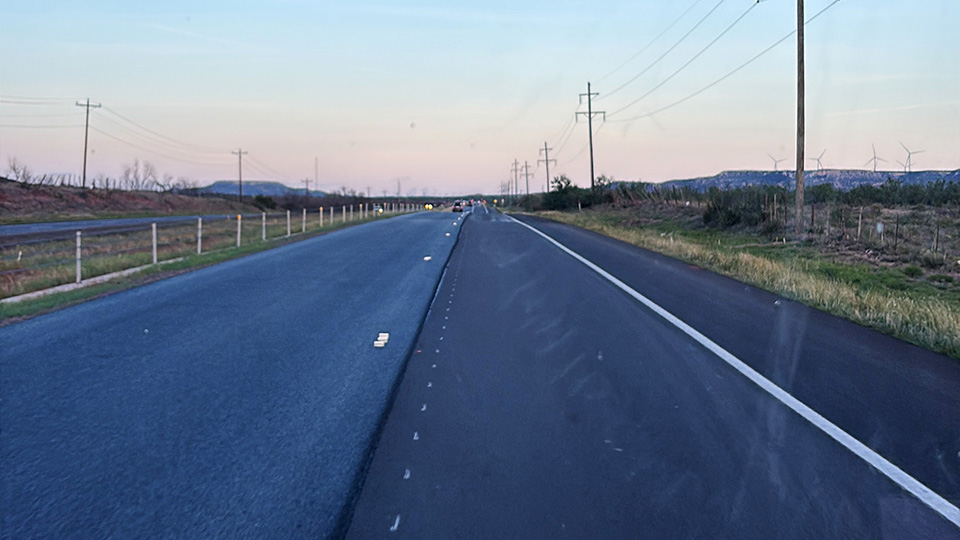
Projectors, Penske, and Plenty of Patience: The Road to Louisville
BY LEE SONNENBERG
If you attended the 2026 AER International Conference in Louisville, you probably walked into a breakout room, saw a screen, projector, speakers, and microphones, and did not give them much thought.
That was exactly what we hoped would happen.
What you probably did not know was that nearly everything you were looking at had traveled more than 1,100 miles from Lubbock, Texas, in the back of a Penske truck.
This story actually started a couple of years ago, when I began looking more closely at what AER spends on audiovisual services for our International Conference. As we began planning for Louisville, the initial estimate for AV from the hotel was approximately $114,000.
That included the stage, screens, sound equipment, and pipe and drape for the general session room, along with the equipment necessary for 13 breakout rooms: projectors, screens, speakers, microphones, and everything needed to make those rooms work.
I was talking about the estimate with my son, Silas, who works in audio engineering, when he said something along the lines of, “I could buy it cheaper than that.”
My response was essentially, “Prove it.”
So he did.
We pulled up the Sweetwater website and began building a basic AV package for one breakout room. By the time we had a projector, screen, speakers, microphones, stands, mixer, cables, and the other necessities, the cost was around $6,000.
That was remarkably close to what AER would spend to rent comparable equipment for a single conference.
That started a much more serious conversation.
Silas and I began working with a sales representative at Sweetwater to design the full system. In one of those wonderfully small-world moments, our sales representative happened to be visually impaired. His father, also visually impaired, had received services from NewView Oklahoma. Of all the people we could have ended up working with on this project, we were working with someone who had a personal connection to the blindness and low vision community.
The final purchase was approximately $92,000.
I will be honest. It took me about a month to actually send the money.
There is something slightly terrifying about wiring $92,000 for projectors, speakers, screens, mixers, microphones, cables, and cases, even when you know the numbers make sense.
We also made some intentional upgrades. Rather than using long-throw projectors positioned farther into the room, we purchased short-throw projectors that could sit much closer to the screens. That reduced cords and equipment in walking paths and eliminated one more potential tripping hazard. We also selected projectors that could better tolerate being bumped or moved.
Accessibility was part of the decision-making from the beginning.
By the time the order was complete, we had 13 projector screens, 13 projectors and cases, 26 speakers, 13 road cases for the speakers, 13 mixing boards and bags, microphones, microphone stands, speaker stands, HDMI cables, extension cords, power strips, gaff tape, and what seemed like miles of cabling.
Then it all had to get to Lubbock.
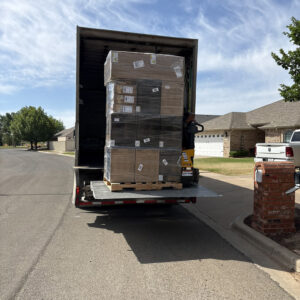
Sweetwater delivery day 1
The first delivery arrived on two pallets that were each nearly eight feet tall. We unloaded them into my driveway, and then I spent the afternoon moving boxes from the driveway into my living room because our storage space was not ready yet.
A couple of days later, another shipment arrived. That pallet was so large the driver could not get it up my driveway, so my kids and I unloaded it from the street.
Then there were the projector screens.
Only one screen arrived with the original shipment, so the manufacturer had to send the remaining screens separately. When they reached Lubbock, the local freight company needed equipment that was not available to deliver them to me. Eventually, I borrowed a truck, went to the freight terminal, picked up the screens myself, and hauled them to the storage facility.
By June, the storage unit was packed.
And then I realized we still had to get all of this to Louisville.
The AV equipment was only part of what had to make the trip. We also had the stage backdrop and furniture, conference office equipment, supplies, T-shirts, a printer, and an ever-growing collection of things that somehow needed to travel from Lubbock to Kentucky.
So I reserved a Ryder truck.
Weeks in advance.
I had a reservation number. I had a confirmation. I had a loading crew scheduled for 9:00 Friday morning. I had divided the approximately 17-hour drive into three manageable travel days.
It was a beautiful plan.
At 8:00 Friday morning, one of our AV team members, Levi, and I arrived at the Ryder location in Lubbock.
The office was dark.
Nobody was there.
There were trucks in the lot, a few with their hoods up, and one person wandering around in the back, but otherwise the place looked abandoned.
I called the number on my reservation and eventually reached someone in Midland.
I explained that I was in Lubbock to pick up my truck.
“Do you have a reservation?”
Yes.
“And a confirmation?”
Yes.
She checked.
There was no truck.
Not in Lubbock.
Not in Midland.
Not in Amarillo.
Despite the confirmed reservation, Ryder had absolutely nothing available for me.
At that point, I had two options: lose my mind or smile and start solving the next problem.
I chose option two, at least externally.
I was doing some rapid mental calculations involving $92,000 worth of AV equipment, a conference in Kentucky, and the fact that I currently had no way to move any of it.
Then I remembered seeing Penske trucks at Home Depot.
A few phone calls later, I thought I had solved the problem. Home Depot had a truck. Levi and I met there, completed the paperwork, worked through a credit card issue, and finally walked outside to look at our new transportation.
Then I read the weight capacity.
3,800 pounds.
The AV equipment alone weighed approximately 3,500.
Back to Penske.
Fortunately, the staff at the Penske location in east Lubbock understood the problem immediately and upgraded me to a larger truck with a liftgate and enough carrying capacity.
Now I had a truck.
Unfortunately, by then my carefully organized loading party had dissolved because everyone had other commitments.
That left Timothy and me.
We spent about an hour and a half loading the AV equipment in a 100 plus degree heat. Then we drove to Jennifer’s house to pick up the backdrop, office supplies, T-shirts, and everything else that needed to go to Louisville.
By the time I got home, I was exhausted. I took a nap, showered, packed, loaded the last few things, and finally pulled away from the house around 7:00 that evening.
I made it onto the highway, accelerated toward the 75-mile-per-hour speed limit, and discovered one final feature of my Penske truck.
It had a governor.
Sixty-five miles per hour.
That was it.
People passed me.
Lots of people passed me.
My original goal had been Dallas. By 10:00 that night, Abilene sounded wonderful. I found a Hampton Inn with truck parking, locked up the equipment, and called it a night.
The next morning I drove to Dallas to pick up my daughter Sadie, who had agreed to make the rest of the trip with me.
We headed east.
Then, near Mount Vernon, Texas, the check-engine light came on.
Of course it did.
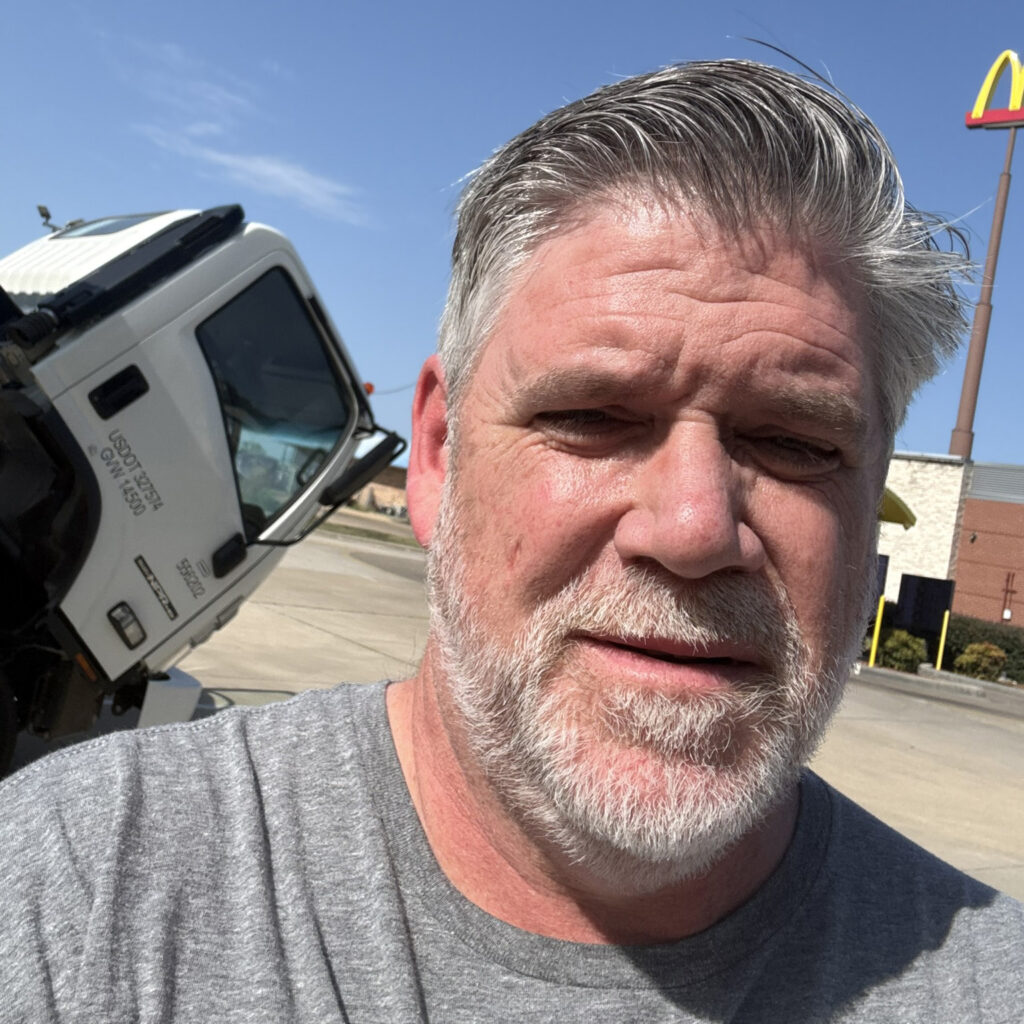
Waiting for repairs in Mt Vernon, TX
I pulled into a TravelCenters of America and called Penske roadside assistance. After several calls and another move to a nearby parking lot, we waited in roughly 100-degree East Texas heat for a technician to arrive.
Sadie worked on her PhD coursework.
I played games on my phone because I had absolutely no interest in checking email.
Eventually, the technician determined that the problem could only be fully addressed by an Isuzu dealership, and the nearest one that could see us was in Tyler.
On Monday.
I had to be in Louisville Monday morning.
I asked the obvious question.
“Can I drive it?”
His answer was essentially yes, unless the warning light started flashing red. If that happened, I should pull over and call again.
Comforting.
We got back on the road.
Our Saturday goal had been Memphis.
We made it to Little Rock.
Good enough.
On Sunday morning, we looked at the route through Nashville, thought about navigating interstate traffic at a maximum speed of 65 miles per hour, and decided to take the scenic route instead.
We headed north through Arkansas, into Missouri, and then across Kentucky.
It was actually a beautiful drive.
And for the record, during the entire day we passed exactly one other vehicle.
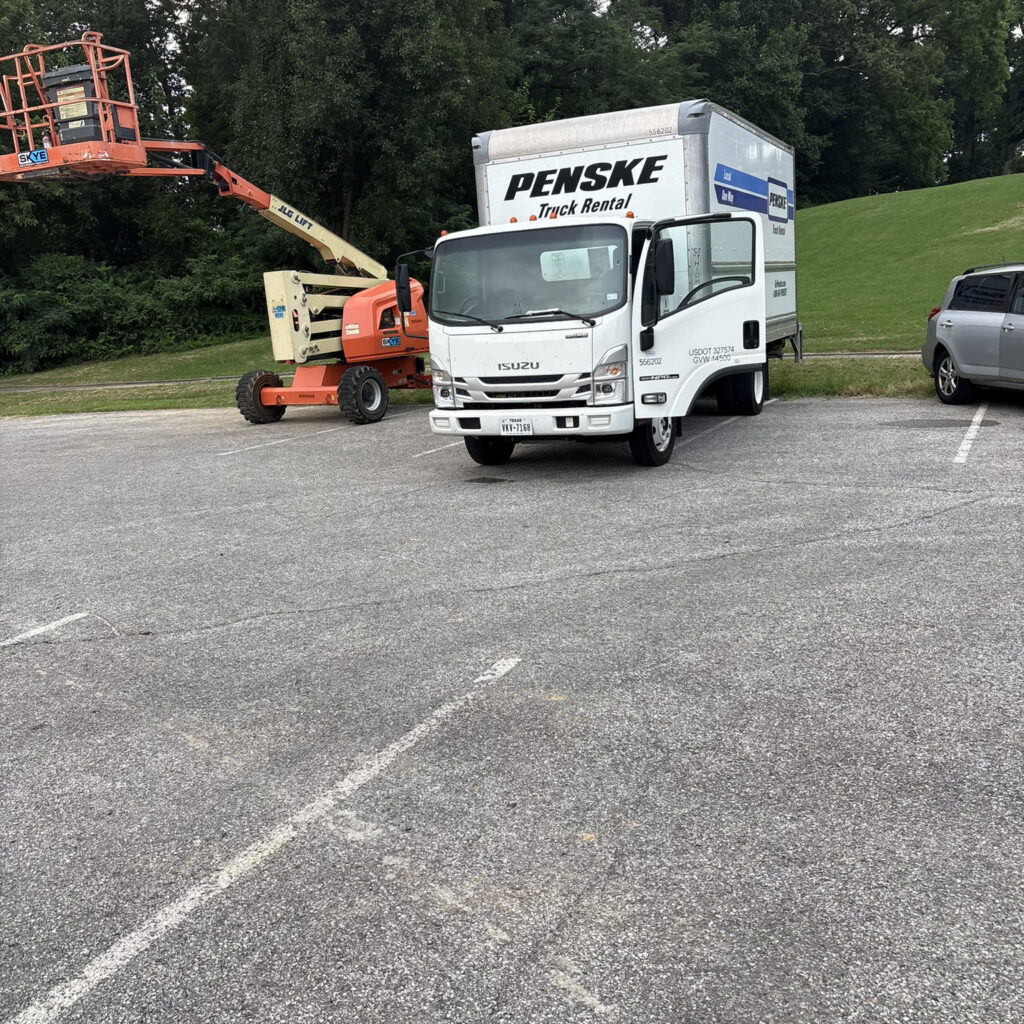
Moving truck, playfully called Harvey, parked at its resting destination, KSB
Eventually, we arrived at the Kentucky School for the Blind, which had graciously agreed to let us secure the truck on campus until we could unload at the hotel. After one final parking adjustment because of construction on campus, we locked everything up and headed to the Marriott.
We had made it.
Mostly.
Monday morning, we brought the truck to the hotel and unloaded the conference office equipment, supplies, and T-shirts.
Tuesday, once the entire AV team had arrived, we brought the truck back and unloaded the real cargo.
Then the team went to work.
The hotel schedule changed repeatedly as different rooms became available, so setups happened at some very unusual times. But by 8:00am Thursday, everything was ready.
Thirteen breakout rooms.
Projectors.
Screens.
Speakers.
Microphones.
Mixers.
Cables.
And, perhaps most importantly, our own AV team.
Silas led a group that included Timothy, Levi, and Jay, all from Lubbock. Throughout the conference, we heard repeatedly from presenters and attendees about how responsive and helpful the AV team was.
That may have been one of the biggest unexpected benefits of the entire project.
When a presenter needed help, our team was there. They knew the equipment. They knew the conference. They cared about whether the session worked.
That level of customer service made a difference.
Then came Sunday.
The conference ended at noon.
We had until 3:00 to clear 13 breakout rooms, pack the conference office, load the truck, and get almost everything out of the meeting space.
Three hours later, the equipment was packed, loaded, strapped down, and locked inside the Penske truck.
We did it.
Levi and Jay drove the truck back to Lubbock in about two days, which I attribute primarily to youth.
So, was buying our own AV equipment worth all of this?
Absolutely.
AER now owns equipment that can serve us for many conferences to come. When we head to Pittsburgh for the next International Conference, we anticipate saving approximately $65,000 to $70,000 in AV expenses simply because we already own the equipment.
We can also potentially use it to support chapter conferences closer to Texas, regional meetings, Professional Division events, or other AER programs.
Yes, we have to store it.
Yes, somebody has to drive it.
And yes, apparently there is always the possibility that a confirmed truck reservation means absolutely nothing.
But the equipment should serve AER for many years. And if a future Board ever decides that owning AV equipment no longer makes sense, professional equipment retains significant resale value.
Most members who attended the Louisville conference never knew this story.
They just walked into their breakout session and expected the projector, microphone, and speakers to work.
And they did.
That is probably the best ending I could ask for.